
By Satya Narayan Mishra* 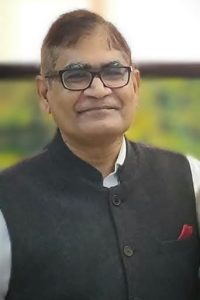 in Bhubaneswar, June 24, 2026: Variously dubbed as the Oracle, the Wizard and the Maestro, Alan Greenspan (March 6, 1926 – June 22, 2026) served asthe Head of Central bank of USA from 1987 to 2006, tasked with setting interest rate, supervising and regulating banks and other financial institutions. He was sought out for advice by Presidents and PMs sought out for advice.
When President Clinton, on assumption of office met him at his office for advice on economic issues, Alan had famously observed: “Economics does not explain everything but no account of world politics is adequate if it does not explore the economic dimension”. He eschewed doctrinaire economics but with a mix of Adam Smith & Ayn Rand, he presided over one of the longest economic booms in US history, from 1991 to 2001.
The economic journalist Justin Martin wrote: “By the dawn of the new millennium, democrats, republicans, wall street, main street, dogs and cats –all were high on the Fed chairman.” Yet his reputation suffered a serious setback when the 2008 financial crash came; the elements that led to the crisis- financial deregulation, derivatives and subprime mortgages– happened on his watch. The Congressional commission set up to investigate the crash also came to the conclusion the self-regulation of the financial sector that Alan stood for ‘stripped away key safeguards, which could have helped avoid catastrophe.
The Smith-Rand Impact
He was a great admirer of Adam Smith’s central dictum of “self-interest” sub serving the interest of all when he famously observed “It is not from the benevolence of the butcher, the baker or the brewer that we expect our dinner, but from their regard to their own interest”. He extended this logic to banks and their customers who were capable of protecting their own interests.
But as Joseph Stiglitz observed in his book Price of Inequality, “private pursuit of self-interest led to the banker’s well –being, with the rest of the society bearing the cost” during the 2008 subprime crisis. He also found Russian émigré writer Ayn Rand and novel ‘Atlas Shrugged’, which inspired generations of neo-liberals ‘intoxicating’. She also confided to the New York Times in 1974: Alan is my disciple philosophically.
Alan’s High Moments
 Alan began his adult life playing the saxophone and clarinet in a New York swing band. Despite his formidable reputation as a banker, journalist Sebastin Malla observes in his biography – The life and Times of Alan Greenspan: ‘America’s political culture adores leaders but is merciless when they fall short – from hero to anti hero, from maestro to villain. His story is a fable of the land that made him.’ Within two months of taking over, Greenspan faced what was to be one of his biggest challenges, the black Monday crash that saw the Dow Jones index drop by 23% in a single day.
The Fed acted decisively to calm the markets in USA and elsewhere by issuing a statement the following day, pledging to serve as a source of liquidity to support the economy. As aRepublican, Alan was anxious about his job prospects under Bill Clinton, the democrat in the White house. They turned out to be partners in a musical concert, embracing both deregulation and deficit cuts. Boosted by the emergence of new technology companies, the technology savvy Clinton & pragmatic Alan saw rising stocks, job growths, increased productivity and low inflation. He also played a major role in the aftermath of the Asian financial crisis, by helping organise a $50 billion bailout of Mexican peso in 1995.He became famous when in a 1996 speech he spoke of irrational exuberance, which was interpreted as his believing the stock market was overvalued.
His View of India
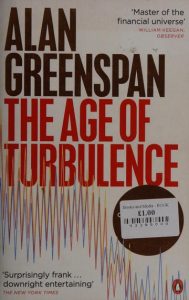 He had a nuanced view of India at the time he wrote his eminently readable memoir ‘The Age of Turbulence’ (2007). While he credited India’s 1991 reform push for tearing a modest hole in India’s regimented economy, he blamed the lack of progress earlier to an idea left behind by the British that had captivated India’s elite –‘Fabian Socialism’. He lays his blame on Jawaharlal Nehru who was ‘entranced by central planning as the rational extension of human beings acting in concert to produce material wellbeing for the many rather than the few’.
Just as Hayek in his book Age of Serfdom debunked central planning in erstwhile USSR, depriving individual of autonomy of choice and leading to inefficiency and authoritarianism, Greenspan believed that government intellectuals in the pre-reform era in India were wrong in believing that centralised planning can far better determine appropriate allocation of resources than ‘erratic free market forces’.
While complimenting the former Prime Minister Dr Manmohan Singh as a reform oriented economist, he was constrained by the enduring socialist inclinations of his governmental coalition in many critical areas. He believed that while India is an admirable democracy, it remains heavily bureaucratic. The political scientist Francis Fukuyama also characterise Indian bureaucracy as a prime example of being trapped by low capacity and excessive rules.
His Legacy
Alan Greenspan deserved to be remembered as one of the great central bankers of the second half of the 20th Century, in a global context, not just at the Fed. He was among the first to recognise the impact of technology on increasing productivity in US, allowing the economy to grow faster than what was thought of without inflation, wrote Roger Ferguson, who served as Fed Vice Chairman from 1999 to 2006.
All these, he was honest enough to admit that there was a flaw in the libertarian conservative ideology that guided him throughout most of his life. “I made a mistake in presuming that the self-interests of organisations, especially banks were such that they were best capable of protecting their own shareholders and their equity in the firms”.
As India moved away from control raj to regulatory raj, the latest buzz of Mr Modi is deregulation of the Indian economy to boost growth further. Going by the US experience of 2008, he must keep in mind the lessons of financial crash and Greenspan’s honest admission of the potential perils of deregulation of the financial sector when key safeguards are stripped to foster market fundamentalism.
* Mr Misra is Emeritus Professor in Economics



Leave a Reply
Be the First to Comment!