
 By Prof Satya Narayan Misra in Bhubaneswar, February 11, 2026: Post economic liberalization in the 1990s, India’s GDP growth has averaged about 6% over the last 30 years, lifting approximately 400 million people out of poverty. Taking the World Bank (WB) criterion of $2.15 a day (2017 PPP) as the poverty line, poverty has decreased from 40% in 2000 to 13% in 2021. But the debate has turned to income inequality, with the latest World Inequality Report (2026) bringing out how income inequality is sharply increasing post 1980.
The following table brings out the widening gap between the top 10% of the population and the bottom 50% during 1980-2020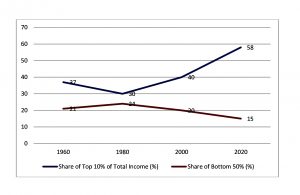 As would be seen from above that that the share of top 10% has increased sharply after 2000, while the trajectory shows a declining trend for the bottom 50% since 1980. Similar asymmetry is also in evidence in terms of global income inequality, where bottom50% account for a measly 8%, while the top 10% account for 53%.The wealth inequality is even worse. Prof Jayati Ghosh and Prof Joseph Stiglitz, the Nobel Laureate who have coauthored the report believe that ‘inequality is a political choice. Where redistribution is strong, taxation is fair, and social investment is prioritized, inequality narrows.’
Unequal Access to Human Capital
The Indian Constitution implores the state to promote socio economic justice by eliminating inequalities in facilities and opportunity as a necessary condition to ‘minimize the inequalities in income’. Apart from rising income inequality already alluded to, the report brings out how average public expenditure is low as $220 in SubSahara Africa, $593 in South East Asia, $ 2941 in East Asia, $2518 in Russia, with Europe and North America spending $7433 and $9025 respectively.
In case of India, while RTE Act 2009 has ensured universal access to public school education, the public education expenditure was around 4.1% of GDP as against NEP’s recommendation of 6%. This impacts on educational outcomes as brought out by ASER surveys, which report very low levels of reading, writing and numeracy outcomes. The foundational learning is abysmal and far behind targets. The WIR emphasizes the importance of adequate funding of public goods like education and health care through progressive taxation.
Why Progressive Taxation Matters
Unchecked wealth concentration can distort democracy (Cage: 2024). The top .01% in the USA account for over 20% of charitable donations. In France & South Korea the richest 10% account for more than 50% of political donation. Corporate donations in the US increased from 4% in 1960 to around 24% by 2012.By 2025, the report brings out, 60000 individuals now control 33% of world’s combined wealth. Zucman in 2024 suggested that minimum wealth tax should be imposed on centi-millionaires ( > $100 m) and billionaires. He considers 2% minimum wealth tax administratively manageable, technically feasible, which will be politically transformative.
The report rightly observes that it is a question of political will. If centi millionaires contribute 2% global wealth tax it will contribute more than $500 B. It will finance education, health and climate resilience. It will ensure that all ultra-rich individuals contribute proportionately. Citizens are more willing to support fiscal system when they see that the very richest, like ordinary workers carry their fair share.
Political Cleavages
In a very perceptive chapter titled “Political Cleavages” the report brings out why the clamor for higher tax on the superrich has declined. Firstly, there is a decline of political working class representation globally. There is a disconnection between income and education political divide in western democracies. Educated elite lean towards the left while affluent elites remain on the right. In nonwestern democracies, cleavages follow ethnic, religious lines. Post Second World War, voters with low level of education was backbone of the leftwing parties. Now highly educated voters vote more for the left and less educated for the conservative parties; a phenomenon contributing to Donald Trump’s victory.
The Indian Scenario
It was Arthur Laffer who established a negative correlation between tax rates and tax collection, with a sweet spot for tax rates that maximizes government revenue. In the 80s, Ronald Regan as US President, following the advice of Laffer cut tax rates significantly, bringing down top marginal tax rate from 70% to 50 % and later to 28%. Federal tax revenue increased. India practiced similar cuts in late 90s As against 50% tax rate at the highest income in the 80s, Chidmbaram’s Dream budget in 1998-99, brought it down at 30%. But the fond hope that the Tax/ GDP will increase substantially has not happened in India as the ratio has hovered around 11-12% since then.
In a poignant revelation post demonetization in 2017, Mr Arun Jeitley as FM had brought how tax evasion is rampant in India. He brought out how only 1.72 lakh had filed IT returns, while nearly 148 lakh people had deposited Rs 80 lakh and above during demonetization! India’s tax collection as % GDP is far below most EMEs like China where it is as high as 16% -20% . Most developed economies have much better tax collection records since unlike India where the informal economy is around 90% , with poor tax compliance records , in DCs like USA , most of the economy is formal and tax evasion is minimal . India has also the dubious reputation that while Personal IT as % of GDP has gone up to 4% , in case of Corporate IT collection as % GDP has plummeted from 4.5% in 2022-23 to 2.75% (2024-25) . The corporate government nexus is palpable.
A Case for Wealth Tax
The WIR (2026) rightly flags the importance of tax justice to inculcate confidence among people that the system is fair in taxing the richest appropriately. With the number of billionaires increasing from 109 in 2014 to 334 now, there is a justifiable suspicion of unholy nexus between oligarchs and ruling party.
Mr Arun Jaitley abolished wealth tax in his budget of 2015-16 by citing poor collection. Mrs Sitaraman had the opportunity to undo this regressive step by imposing 2% wealth tax on the super-rich, taking a leaf out of the recommendation of World Inequality Report. It would have been a sensible step towards tax justice. By funding social sector programs and public goods through increased tax collection rather than fueling debt burden further, the FM has melded tax justice with human capability development.



Leave a Reply
Be the First to Comment!