
 Professor Satya Narayan Misra* in Bhubaneswar, October 13, 2026: The Nobel Peace Prize has been awarded this year to 85-year-old South African Judge Navi Pillay of Indian descent, who chairing the UN Commission has concluded that Israel is guilty of genocide in Gaza. It said that the country’s PM Netanyahu, its President Herzog and its former defence minister Gallant had ‘incited the commission of genocide’.
Israel which refused to cooperate with the Commission has responded by saying: Awarding Pillay the “Nobel Peace Prize is the grotesque weaponization of an award to legitimize anti–Israeli hatred and prejudice.” The Nobel Committee in it’s a sharp riposte has said that “in awarding this award to Pillay, the Committee wants to remind the world that the rule of law-national and international –underpins the system that we have set up to ensure peace and resolve conflicts non-violently”.
Hours after the announcement, the Trump administration unveiled broad new sanctions against the ICC, on which Pillay once served. The US Secretary of State Marco Rubin, saidthe measureswere to ensure the court would never prosecute the Americans. The ICC in reply has said “the sanctions were an attempt to obstruct the course of justice and to prevent the court from doing what it was created to do”.
The Beginning
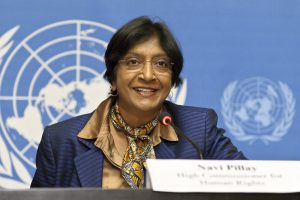 Navi Pillay, who is caught in this crossfire of bold judicial pronouncements & vilification, was born in 1941 in the poor neighbourhood of Durban whose grandparents had come in the 1890s from India as indentured labourers for Natal’s sugar plantation. Her father was a bus driver, who wanted his daughter to have the best of education. In 1973, as a lawyer she won inmates of Robben island, which included Nelson Mandela, the right to legal representation.
Earning a doctorate in Law from Harvard, she was nominated by President Mandela to serve the International Criminal Tribunal for Rwanda, which witnessed genocide from April to July 1994, leading to gruesome death of about 662000 Tutsis. Spending eight years in the Tribunal & four as President, she is remembered most reverentially for two startling cases.
Rape as a form of Genocide
In the case of The Prosecutor Vs Jean-Paul Akayesu, the court indicted Akayesu, a mayor, for being individually responsible for the death of Tutsis during the Rwandan genocide. It was during the case that Pillay was able to set an international legal precedent which considered rape as a form of genocide and a crime against humanity. The court argued that Akeyesu was mayor of the Taba commune where many Tutsi women took refuge and purposefully instructed the militia group to target and rape civilian women.
 ‘Sexual assault had the intent to destroy in whole or part, a targeted group. Rape perpetrated against Tutsi women only manifested the specific intent required for these acts to constitute genocide.’ Pillay poignantly observed: “From time immemorial, rape has been considered as spoils of war. Now, it will be considered a war crime. We want to send a message that rape is no longer a trophy of war”. Akeyesu had to serve life imprisonment.
The Media Case
She also served on the Nahimana and Ngeze trial regarding the role of radio television anchors and magazine editors play in spreading hate propaganda against the Tutsis. Nahimana, a Rwandan historian, was indicted for direct and public incitement to commit genocide at the RTLM. Hassan Ngeze was also charged for incitement to genocide in his work with the magazine. This case is significant as it flags the role media plays in politics and public opinion and its real life ramifications. The hate media trials received global attention since it was the first time since the Nuremberg trials that hate speech had been prosecuted as war crime. In December 2003, Nahimana was sentenced to life imprisonment, guilty of genocide, incitementto commit genocide and crime against humanity.
A Stark Contrast
Last year the Nobel Committee honoured Venezuelan Opposition leader Maria Machado, a staunch ally of the USA & Israel “for her tireless work promoting democratic rights for the people of the people of Venezuela to achieve a just and peaceful transition from dictatorship to democracy”.
Machado farcically gifted her medal to Mr Trump at the White House. The symbolism shows the irony of genuflecting before Trump who has a dubious reputation of breaching international law with impunity, first by abducting President Maduro in January 2026 and then launching military strikes in consort with Netanyahu against Iran in February 2026.
The choice of Ms Pillay for the peace prize was redemption for the Nobel Committee which recalls that lasting peace must be “built on legal principles, not on the will of the strong or a fragile balance of power.” In Plato’s Republic, Thrasymachus, a Sophist, presents a cynical view that justice is simply the will of the powerful, challenging Socrates notion of justice as a virtue tied to the welfare of the state and its people.
His ideas regarding power had influential successors like Machiavelli & Nietzsche and present day practitioners like Putin and Trump. In honouring Ms Pillay, seems to be rejecting the Thrasymachian doctrine being adapted by leaders like Putin, Trump and Netanyahu and that jurists like her who believe that law and not might must govern relations between nations.
Between Law & Might
It’s common knowledge how USA as the super power is using military superiority to nakedly grab resources while seeking to dismantle institutions, in whose creation it had a leading hand. In Iran, approximately 6000 people have been killed and around 23000 wounded since the war started. In Gaza, close to 75, 000 people have been killed by Israel, of which 70% are women and children, whose number is put at 21000. In the war against Ukraine around 1.5 lakh have lost their lives in Ukraine since 2022.
In Global South, the military junta have waged unremitting violence against the country’s citizens, including the expulsion of lakhs of Rohangiyas since 2017, with scarcely a world response. All these actions stem from a faith in infallibility of power, cocking a snook at an international order painstakingly built since1945. In such a dystopic milieu, the Committee recognises judges like Ms Pillay “who guard the thin line between order and chaos”, and hold powerful people accountable to flagrant violations to rule of law.
• Professor in International Law & Public Policy



Leave a Reply
Be the First to Comment!