
 Professor Satya Narayan Misra in Bhubaneswar, October 3, 2026: Gandhi was a voracious reader and tireless writer. Some books impressed him so much that he even translated them into a regional language for consumption by a larger group of people and recommended most of his favorite books for reading.
However, pride of place of his reading list will go to John Ruskin’s Unto This Last (1860). Gandhi read this book gifted by Henry Polak during a train journey from Johannesburg to Durban (1904) and its impact was metamorphic.
It was Ruskin’s collection of four essays on the ‘politics of economics’ where he put forth his idea of an economy based on the consideration of humanity and the idea that economics must have its roots in ethics. It was a powerful polemic against the prevailing ideology of the pursuit of wealth maximization advocated by Adam Smith and hedonism propounded by John Stuart Mill.
Based on the ideals of the book Gandhi established the Phoenix settlement in 1904 in Natal, South Africa, where people followed community living, practiced non-violence, and embraced spirituality based on Ruskin’s teachings. He successfully practiced community living, self-sufficiency. Physical labor was considered superior to intellectual work and the life of the tiller of the soil and handicraftsman was considered life worth living.
The Apostles of Non Violence
Two greatest exponents of nonviolence as a way of life were Tolstoy, the Great Russian novelist, and Gandhi. He read Leo Tolstoy’s “The Kingdom of God is Within You (1893)” when he grew skeptical of non-violence. Leo Tolstoy invoked a storm within the Christian community by stating why people must dismiss violence and look inside themselves for answers about morals. Tolstoy challenged the modernization of the church and spoke of a society based on following Jesus’ literal teachings of ‘turning a cheek’.
This book helped to ease his mind about the non-negotiability of nonviolence as a way of life. While being taken to the court in handcuff following an agitation in Transvaal, he carried a copy of The Kingdom of God with him. Tolstoy’s concept of ‘Bread Labour’ was included in Gandhi’s Ashram vows. Earning livelihood by the sweat of the brow was mandatory for inmates.
He even mentioned in his autobiography that this book made him a firm believer in ahimsa. The Tolstoy farm was built on the land offered by Herman Kallenbach, a German architect who designed the living quarters, workshops, and a school. There were no servants on the farm and all work from cooking down to scavenging was done by the inmates.
Tolstoy Farm is in every sense a finest example of globalization in the early 20th century when the land was contributed by a German, the driving force was an Indian barrister, based on the ideals of a Russian novelist, to fight against the pernicious practice of apartheid in South Africa.
While the idea of community living and nonviolence was contributed by Ruskin and Tolstoy, the idea of the civil disobedience movement was implanted in his mind while he was studying in England by reading Thoreau’s essay The Duty of Civil Disobedience. Thoreau, the transcendentalist thinker, wrote: Prison is where a just man belongs under an unjust government’. Both in South Africa and India, the prison was like a second home to Gandhi against an unjust, imperial government.
Walking the Straight Path
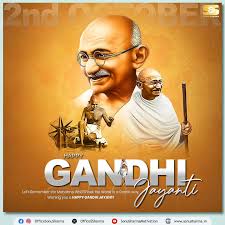 When Gandhi was asked about the ideology that he follows he had famously said : “I have neither read Smith nor Marx, but when in doubt a little voice tells me, do not look left or right but follow the narrow straight path”.
But a careful reading of Gandhian writing will show that he was averse to all notions of class conflict as Marx had propounded in Das Capital (1867). He was equally forthright in rejecting the concept of human being rational always, with self-interest and wealth maximization as the main driver, as argued by Adam Smith in his magnum opus ‘The Wealth of Nations’.
He countered Marx with his trusteeship theory where he perceived that the wealthy are trustees of their belongings and would have a moral obligation to use their wealth for the benefit of the society as a whole. As against Smith’s dictum for wealth maximization, he was more inclined to plain living, locally oriented production, and Sarvodaya; welfare of all. Economics and ethics were thickly intertwined in his vision of India living in its villages, self-sufficient and in harmony. Like Ruskin, he strongly believed that industrial capitalism is unsustainable and devastating to the human spirit.
The Practioners
Gandhi seems to have become a relic of the past, anachronistic and a totem recalled during certain days of the year. Despite cynicism about Gandhian ideas, we have the sterling example of people like Bunker Roy who have put Mahatma Gandhi’s philosophy of village self-rule, local self-reliance and dignity of labour in to practice. By founding the Barefoot College in Tilonia (Rajasthan), he has shown how it is possible to empower illiterate and semi-literate women to become solar engineers and community. His work demonstrates how traditional knowledge and decentralized hands on development remain powerful solutions for sustainable rural upliftment.
Similarly, devout Gandhians like Ela Bhatt have dedicated their life for women’s self-reliance by setting up organizations like SEWA, as a union of self–employed, informal sector women workers.She also inked the Gandhian vision of 100-mile communities where the basic needs of daily life-food, clothing, housing, health, education and banking can be achieved largely within a hundred-mile area through innovative solutions.
His Relevance
Gandhi used to say that India lives in its villages. Sadly the villages where 70% of India lives, the economy remains the troubled script of India. Post economic liberalization in India, while industry, trade, services and financial sectors have received enormous attention, the village economy has not harnessed the bonanza that economic reforms has ushered in the other sectors due to lack of political priority after the Green Revolution.
 As against an average growth of 7% per year in other sectors, the farm economy is stuck with the Hindu rate of growth rate of 3%, post 1991, with a large surplus labor and low productivity in most parts. Prof Joan Robinson after visiting China had observed in Delhi in 1976 that Mao’s China is more Gandhian than Gandhi’s India. She was possibly alluding to the rapid stride that the agriculture sector had made in China. Bunker & Ela hold candles to Gandhian ideas thathave both salience &relevance in terms of durable rural transformation.



Leave a Reply
Be the First to Comment!