
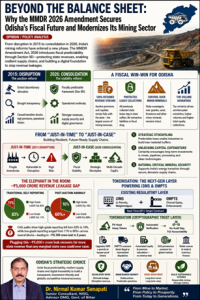
 Dr. Nirmal Kumar Senapati* in Patna, September 1, 2026: The Mines and Minerals (Development and Regulation) Amendment Act, 2026 marks the next stage in the decade-long transformation of India’s mining sector. The 2015 MMDR reform disrupted the old discretionary allocation system and introduced competitive auctions, bringing greater transparency but also a period of aggressive bidding, regulatory adjustment and operational uncertainty.
The 2026 amendment of the MMDR Act represents a phase of consolidation, with greater emphasis on fiscal predictability and continuity of mining operations. For Odisha, this could be an opportunity to strengthen both revenues and long-term mineral security.
Concerns over restrictions on state-level cesses have dominated the debate. But Odisha’s mining revenues continue to be supported by royalties and auction premiums, while previously collected levies remain protected. The state also retains its role over minor minerals.
The larger economic gain could come from continuity of production. Greater fiscal certainty can encourage miners to maintain output and undertake long-term investments in mines, processing plants, slurry pipelines and other infrastructure. Higher and more consistent production also means a broader and more predictable revenue base for the state.
The mining economy also needs to move beyond the fragile Just-in-Time supply model. Steel, aluminium, power and other mineral-dependent industries require greater protection against regulatory disruptions, supply shortages and price shocks. A Just-in-Case strategy would encourage strategic inventories, long-term contracts and multi-decade investments, strengthening Odisha’s role in India’s critical-mineral and manufacturing supply chains.
For Odisha, however, fiscal policy is only one side of the equation. Grade suppression, under-reporting of mineral quantities and physical leakage can potentially cost the exchequer far more than marginal changes in cess collections.
This makes the next generation of mining governance critical: the state needs to know what was mined, where it was mined, its grade and quantity, where it moved, and what revenue was due—before the mineral disappears into the supply chain.
Odisha already has a substantial digital foundation through i3MS (Integrated Mines and Minerals Management System) and OMPTS (Prevention of Theft, Smuggling and Illegal Mining). The objective should not be to replace these systems but to add a trusted digital token layer over them.
Each verified mineral consignment could carry a digital identity linked to its mine location, grade, quantity, production record, royalty and auction-premium obligations, transport route and destination. The principle is simple: every tonne should have a digital identity, and every digital identity should correspond to one verified physical tonne.
The combination of MMDR 2026, fiscal predictability, resilient supply chains and digital mineral traceability offers Odisha an opportunity to move beyond being merely a mineral-producing state.
The next generation of mining governance should aim to make Odisha’s mineral economy more transparent, investment-friendly, technology-driven and globally competitive—securing not only the mineral beneath the ground, but also the value and revenue generated throughout its journey from mine to market.
* Senior Consultant, National Institute of Smart Government (NISG), Advisor, Department of Mines and Geology, Govt. of Bihar



Leave a Reply
Be the First to Comment!