
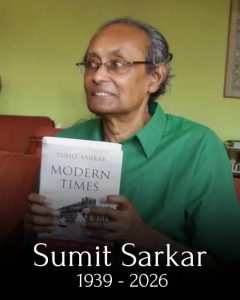
 By Prof Satya Narayan Misra* in Bhubaneswar, August 28, 2026: Barring Andre Beteile, the gentle demure sociologist who passed away last February, no other academic’s death in recent times has been remembered with so much fondness, respect and outpouring of emotion as in case of Prof Sumit Sarkar, who was called as ‘Sumit’ by his numerous students, peers and seniors.
There is an avalanche of tributes mostly by the students he taught in the 90s and interestingly by Ravish Kumar, the journalist who recounts how he travelled from caste ridden and feudal Bihar to have a wholesome understanding of democracy as Sumit’s student in the Delhi University. He will be remembered primarily for his iconic and classic text book ‘Modern India’ he wrote in 1983, which I bought for Rs 26.50 as a UPSC aspirants.
Even after forty three of my academic joust with Sumit, as a counterpoint to the hagiography of Bipin Chandra of the Congress and Gandhi in achieving independence, its musty smell of invaluable ideas, heavily underlined thought process highlighting the importance of the subaltern in shaping, coaxing political leadership at the top with counterpoints to achieve independence give me goose bumps as they remain permanently burnished in the mind.
Though a student of economics, my dalliance with modern Indian history as an avocation could not have been more delicious, and rewarding, as Sumit’s enduring contribution still remains very relevant in the polarised times that we are traversing.
History from Below
Sumit opened his academic arsenal with a masterly monograph “The Swadeshi Movement in Bengal (1903-1908)” in 1973, where instead of praising elite leaders, he flagged the failure of the movement to recruit mass Muslims & low caste support. He brought out the structural limitations and internal contradictions of early Indian Middle class.
His classic contribution of freedom struggle, published a decade later brought out how besides Congress resolutions, constitutional negotiating and towering presence of Gandhi, the subaltern like the peasants, workers, Adivasi, and anonymous crowds played a definitive role. That was ‘history from below’. He did not replace leaders with masses. Rather he explored the unstable relationship between them. While Gandhi mattered, so did the subaltern groups.
Though he was a fellow Marxist, in his approach to freedom struggle he was sharply different from Bipin Chandra’s analysis in ‘Freedom Struggle’ written in 1972 where he focussed heavily on the INC as the central backbone of anticolonial struggle. For Sumit Sarkar, it was a complex interplay of socio economic structure where grass root dynamics operated with elite politics.
 Taking a critical view of Congress driven national movement, Sumit highlighted the salience of subaltern movement and pressures exerted by workers and peasants from below. For him, greater emphasis on automatic action of ordinary people must be given due credit, the way they pushed the leadership further than it wanted to follow, as in case of suspending the Civil Disobedience movement by Gandhi in 1934.
The Angst Against Communalism
Post demolition of Babri Majdi, Sumit along with Tanika (his wife), Tapan Basu & Sambuddha Sen wrote a bitter polemic against the rising tide of the Hinduvta Movement in a book titled “Khaki Shorts & Saffron Flags” in 1993. It’s a penetrating analysis of the Hinduvta movement, its origins from a local RSS unit to a multi headed hydra of menacing proportion.
“At the heart of Hinduvta lies the myth of a continuous thousand year struggle of Hindus against Muslims as the structuring principle of Indian society. The myth of Muslim invader and Hindu resistance has also been employed to prove that Hinduvta represents the true, native nationalism”, write the authors. They believe that the rise of Hinduvta is not accidental but result of highly organised everyday cultural mobilization.
This book remains essential reading to understand the institutional and contemporary roots of contemporary politics of the BJP to foment religious polarisation. From a Marxist historian, Sumit segued in to a subaltern scholar to a defender of secular democratic history. Romillla Thapar in her autobiography ‘Just Being’, also shares the same angst about the sordid rise of communalism. She has also pointed out how the two basic theories of Hinduvta; hostility of Hindu and Muslim towards each other and superiority of Aryan race do not stand to scrutiny as professional history stands on the bedrock of secularism.
Modern Times
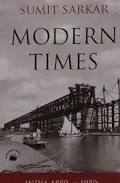 When Sumit was asked to review his classic Modern India he refrained from it and wrote Modern Times in 2014 instead. It is a deeply analytical historical work that reimagines the trajectory of colonial India through the lenses of economy, environment & culture. He looks at forest policies that favoured imperial timber extraction while marginalizing nomadic and tribal communities. He challenges rigid nationalist orthodoxies regarding deindustrialization and drain of wealth as Dada Bhai Naroji propounded.
Instead he points to regional variations and the rise of industrial capital like the Tatas and complex trade patterns. Sumit steers clear of simple nationalistic binaries and uncritical post-colonial dogmas. In an earlier book Beyond Nationalist Frames written in 2002, Sumit writes that there ae two contemporary threats to objective history writing. One is religious nationalism and the other is the extreme scepticism of post modern theories.
Abiding Contribution
His Marxism was fundamental to him but never doctrinaire. Class mattered but never by itself. Caste, religion, gender and cultural practices could not be consigned to the secondary superstructure as Marx had contemplated. Economic determinism has serious limitation. Sumit’s exposure to the destructive power of unthinking Hindu biases made him prescient about the rise of Hindu nationalism of the present.
Sumit grasped the implication of Hindu nationalism in subjugating minorities, the marginalised and the poor to the rule of the powerful. Just as the past sharpened the sensitivities of the historian to the possibilities and dangers of the present, Sumit remains the exemplar of a dialogic historian. In the academic world not innocent of vanity, he possessed very little of it. His shy demeanour, twinkling eyes, gentle sarcasm coexisted with a razor sharp judgement. His enduring contribute are not to take a binary view of history & to keep the subaltern as the anchor of historical understanding.
• Prof Misra teaches Economics & Public Policy



Leave a Reply
Be the First to Comment!