
 By Satya Narayan Misra* in Bhubaneswar, November 25, 2026: The looming 150th anniversary of Test cricket’s inception is an ideal time to consider the format’s greatest players to be part of a potential World XI squad. Over three thousand men have earned test caps. To choose 11 players, who can be considered as the best out of them can be nightmarish, if not foolhardy?
Dickie Bird, the most admired umpire, who stood in 66 tests with his unique mix of firmness and eccentricity in his Autobiography, carried out this herculean exercise of choosing World XI squad, based on what he saw from the 60s.
The list includes Barry Richards and Gavaskar as openers, followed by Viv Richards, Greg Chappell, Graeme Pollock as the middle order batsmen, Sobers as all-rounder, Knott as Wicket keeper and Hadlee, Lillie, Holding as the pace trio, and Gibbs as the spinner. It’s a tempting list to embrace, except that it excludes Jack Hobbs, the legendary opener and Don Bradman, who took over the mantle of best batsman the world has seen from Hobbs in 1930& touched near 100 as test batting average!
The Openers
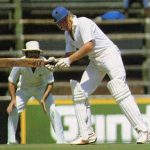 Barry played only 5 tests against Australia, averaging 75, as South Africa ceased to play after 1970 due to apartheid. But as John Arlott, the legendary BBC commentator (1946- 1980), poet and wine connoisseur writes in his magnificent tome “Greatest Batsmen” (1986),”Barry was a batsman of staggering talent, who could toy with best of bowling”. He hit 1000 runs in a season in England nine times, scored 356 for South Australia in 1971, with 325 in a day against the likes of Lilee of Western Australia. Nine times he scored a century before lunch.
Sunil Gavaskar, makes an automatic choice as opener, with nimble feet who was tremendous player off both back foot and front foot. Extremely sound in his defence he hit five centuries in Australia and seven in the Caribbean against the very best of fast bowling and equally twinkling on his feet against Pakistan in his last test in 1987 on a sharply turning track to score 96!
The Mindboggling Middle Order
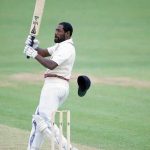 Vivian Richards, the most brilliant and prolific gum chewing batsman, with a swagger in the 80s, is an automatic choice for all connoisseurs to bat one drop. He had all the orthodox strokes –even those in defence, he played with killing power. His favourite stroke at Lord’s is a most improbable heave to cart a ball from outside the off-stump over mid-wicket in to Moudstand. He married brutality with robustness, the way he mauled England in stifling heat of summer of 1976 to score 829 with an average of 118.4. His strike rate of 70.9 hasnot been bettered in the 80s.
The next batsman in the pack is his Caribbean compatriot, Brian Lara, the dashing Prince of Trinidad. He along with Sachin Tendulkar, the prodigy of the Mumbai maidans were the best in the business in the 90s. The debate over who was the better Test batsman remains visceral. Richie Benaud believes that Sachin is the best batsman to straddle the turf.
Lara was more effervescent, with his characteristic high back lift, while Tendulkar was more methodical. Both excelled against Australia, the gold standard throughout their careers, with a slight vulnerability against Mc Grawth. While 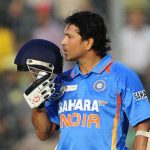 Tendulkar was a superior player of pace, Lara has a strong claim of being the best player of spin bowling of all time. In terms of sheer insatiable appetite for run scoring, Tendulkar’s career is almost impossible to best. But in terms of pure aesthetics and joy that you want to see at the crease, there has not been a more attractive player than Brian Lara.
All Rounder & Wicket Keeper
Sobers was simply the best and was four cricketers rolled in one:a greatleft handed batsman who combined pugnacity with gargantuan run-scoring, a left arm swing bowler, who could be lethal with the new ball, a left arm orthodox spinner and a brilliant close to the wicket fielder. His record in England in 1966 was quite incredible -772 runs at an average of 103.1 and 20 wickets at average of 27.2, winning the series 3-1. With a strange, forward-leaning, sag-kneed walk, he scaled all the heights –and did so with a glorious joyous athleticism, whose cricket transcends records.
About Sobers, Bradman wrote: ‘Having seen all the players of the last 50 years, I believe that Sobers’s 254 at Melbourne against Australia in 1971 was the greatest exhibition of batting seen in Australia’. Gilchrist pips the scale over Alan Knott, as he redefined what a wicket keeper could be.
Until his debut, all Test wicket keepers in history had an average of 23.8, with Knott an average of 32.7. Gilchrist averaged 47.6, with a strike rate of 82, better than Viv. Gilchrist was not quite good a gloveman as some specialists who had come before, yet he was a far better keeper with 416 dismissals than is widely remembered. Australia sacrificed little in efficiency behind the stumps while gaining a transformative batsman.
The Bowlers
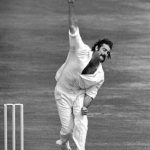 Dennis Lillie will lead the pack as a seminal figure in the evolution of fast bowling, combining pace, hostility, athleticism and range of deliveries that it has not been seen before. He had a beautiful approach to the wicket; stood up in his delivery stride, left knee stiff as a poker; his follow through was perfection; ‘and his whole action poetry in motion’, wrote Dickie Bird.
For an island that produced Roberts, Holding, Garner and Croft followed by Marshall, Walsh, Patterson, Ambrose from 1980-1995, Lloyd who captained all of them wrote “Marshall was the Best & Smartest”. To see Marshall was to see the whole range of fast bowling, a combination of swing and seam, allied to a full length that made him extraordinary in England. He was equally effective on placid Asian wickets. Steyn must be considered a more well-rounded bowler than Donald and Rabada. He fared better in Asia, bowling fuller and straighter to target the stumps and use the low bounce to his advantage. He showed the ultimate mark of bowling greatness: the capacity to transcend the conditions.
Shane Warne shared Sobers’s sense of showmanship. There was never a ball of the century until Warne’s delivery in the Ashes , which fizzed from outisde leg stump to uproot Gatting’s off stump . His most remarkable attribute was accuracy; he offered both control and venom even during the periods of play least conducive to spin. He struggled against Tendulkar and Lara; but that does not undermine his claim being the best test match spinner of all time.
The all-time best World XI would read: Barry Richards, Sunil Gavaskar, Viv Richards, Brian Lara, Sachin Tendulkar, Garfield Sobers, Adam Gilchrist, Dennis Lilee, Malcolm Marshall, Dale Steyn & Shane Warne. Sadly the list excludes Sultan of swing Wasim Akram, Oceania’s best pace bowler Richard Hadlee and ice cold great all-rounder Jacque Kallis .
• Satya Misra is a Cricket Buff



Leave a Reply
Be the First to Comment!