
 By Nageshwar Patnaik in Bhubaneswar, November 3, 2026: Odisha, which pioneered reforms in the power sector way back 1990s, is now strengthening its transition to non-fossil fuel-based power generation by having more clean energy projects. It has attracted prospective investment proposals worth around Rs 1.17 trillion for clean-energy projects with a tentative capacity addition of 11,742 megawatt (mw) on Tuesday.
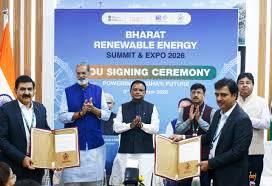
The state government signed deals with 18 companies at the Bharat Renewable Energy Summit and Expo 2026 in New Delhi on Tuesday. The investment proposals span pumped storage hydropower, solar, wind, hybrid renewable energy, battery energy storage, green hydrogen, green data centres and other emerging clean-energy technologies.
Chief Minister Mohan Charan Majhi described the investment commitments as a watershed moment in Odisha’s clean-energy transition. Outlining the state’s ambition to source 74 per cent of its installed power capacity from non-fossil fuel sources by 2047, he said the vision is to meet at least 33 per cent of industrial electricity consumption through green power at competitive tariffs.
“The Odisha government has sanctioned Rs 15,948 crore under the Mukhya Mantri Shakti Bikash Yojana for modernising and expanding the state’s power transmission network. Besides, the industrial ecosystem, renewable energy potential and strategic ports at Paradip, Dhamra and Gopalpur offer significant opportunities for investment in clean energy and green hydrogen,” he said, assuring time-bound approvals and strengthening transmission infrastructure ahead of generation.
The proposed capacity addition of nearly 11.74 gigawatt (gw) could significantly expand Odisha’s renewable energy pipeline and strengthen the country’s efforts to achieve its ambitious target of 500 gw of installed electricity generation capacity from non-fossil fuel sources by 2030.
 These planned investments are also expected to help address one of the major challenges confronting India’s renewable energy expansion, ensuring adequate energy storage, grid stability and reliable power supply as the share of intermittent solar and wind generation increases.
The proposed investments come at a time when India is accelerating its renewable energy deployment. The country crossed 300 gw of installed non-fossil fuel-based electricity generation capacity in July, reaching 300.5 gw, or more than 60 per cent of its 500 gw target for 2030. The non-fossil share has also exceeded 54 per cent of the country’s total installed electricity generation capacity.
Addressing the Odisha State Plenary on investment opportunities in the renewable energy sector, Union Minister for New and Renewable Energy Pralhad Joshi highlighted opportunities in pumped storage, floating solar, wind power, energy storage, green hydrogen and green ammonia, while emphasising the importance of cooperation between the Centre, state governments and private industry to accelerate India’s clean-energy ambitions.
The agreements for investments were signed with Hinduja Renewables Energy Pvt Ltd, Renew Green, Shivalaya Construction Limited, Suzlon Renewable Development Ltd, MeghaMani Renew Energy Pvt Ltd, Evergreen Renewables Pvt Ltd, Datta Power Infra Pvt Ltd, CD Hydro, GSP Infra, Virudhaka Renewable Energy Pvt Ltd, Maclec Technical Project Laboratory Pvt Ltd, Fenice Hydrogen, Ravi Renewables Pvt Ltd, XPERTNEST and India Energy Storage Alliance (IESA).
Apart from this, Grid Corporation (Gridco) also signed separate institutional cooperation agreements with the Centre for Mission on Energy Transition, anchored at Maulana Azad National Institute of Technology in Bhopal, Madhya Pradesh Urja Vikas Nigam Limited and Indian Institute of Technology (IIT), Bhubaneswar. These agreements will help establish a framework for cooperation in research, technical development, renewable energy integration, grid modernisation and emerging power-system technologies.
The institutional collaboration with Madhya Pradesh is expected to facilitate knowledge sharing, joint research initiatives and capacity building, while strengthening the technical capabilities of both states to manage the changing requirements of the electricity sector.
Deputy Chief Minister Kanak Vardhan Singh Deo said the state had successfully met a peak electricity demand of approximately 6,242 mw during the summer without scheduled load shedding. Odisha has considerable potential for developing pumped storage projects, floating solar installations and wind energy, besides pursuing green hydrogen and green ammonia production hubs at Gopalpur and Paradip, he said.
E arlier, Singh Deo had said 16 projects worth around Rs 2 trillion were approved by the state and an additional Rs 30,000 crore was expected to be invested in strengthening transmission infrastructure, a critical requirement for integrating large volumes of renewable energy into the grid and supporting future industrial growth.
Last month, the US-based Institute for Energy Economics and Financial Analysis (IEEFA) put Odisha’s requirement of investment in the renewable energy sector over the next decade at Rs 1,09,980 crore. Renewable energy accounts for 67 per cent of this requirement, storage for 21 per cent and grid infrastructure for 12 per cent, IEEFA said in a report.



Leave a Reply
Be the First to Comment!