
 By Satya Narayan Misra* in Bhubaneswar, November 1, 2026: Calcutta of the 50s was a veritable cocktail of coffee, culture, and cacophony savoured in the addas, where the early seeds of art cinema were being planted by an untrained trio of film aficionados, Ray, Ghatak, and Mrinal. Jean Renoir came to shoot his film The River in 1950 and Ray saw the master from close quarters.
De Sica’s Bicycle Thieves (1948) and neorealist drama prompted Ray to make the magnum opus Pather Panchali in 1953, winning international acclaim. Ghatak was the youngest of the troika and his first film, Nagarik (Citizen), was made in 1952 but released after he died in 1977.
He made only eight feature films, yet he made a profound impression first on the Bengali intelligentsia and, later on, film buffs all over India. Working during a period dominated by Satyajit Ray, he struck out on a completely original path-not by design, but by the distinctive nature of his genius.
It was Ray, who persuaded Mrs Gandhi as Minister I & B to appoint Ritwick as Vice Principal of FTI, Pune in 1966, where he deeply influenced a group of students who later on became notable filmmaker like, Mani Kaul, Kumar Sahini & Adoor Gopalkrishnan. His films never won an award, and never went abroad except to make a film in Bangladesh. He died in 1976 of alcohol abuse; yet he remains a cult figure, an anti-establishment hero for many filmmakers and film buffs in India.
The Ghatak Retrospective
When a retrospective of his films was screened in the New York Film Festival for the first time in 1996, his films came as a revelation to the uninitiated. Of his eight films, Ajantrik (1958) was critically acclaimed. Meghe Dhaka Tara (1960) &Subarnarekha (1962) are acknowledged masterpieces whose stature has increased with time.
A River called Titas made in 1973 is also a film of unquestioned greatness. In discussing Ghatak’s craft, it is necessary to note his extraordinary use of sound. In Meghe Dhaka Tara, the sound of whiplash is a conventional literary simile for humiliation, transferred to cinema in an oddly effective manner.
In Titas, where the young fisherman gets married to his girl, Ghatak introduces a sound of heavy breathing, clearly suggesting sexual union, building it up to a climax. Partha Chatterjee following the retrospective wrote: “You were either singed by the fire of his genius, overwhelmed by his passionate humanism, touched with his childlike simplicity or simply repulsed by the arrogant manners, crass speech & melodramatic posturing of a prophet.”
The Tagore Influence
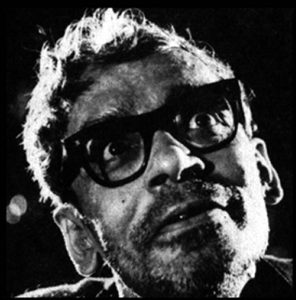 Ghatak was born and bred under the cultural umbrella of Tagore. Ghatak made intensive use of Rabindra Sangeet. In Subarnarekha,”Aaj dhanerkhet ayroudr achayarl ookochoori khela”, (Today in the paddy field, light and shadow are playing a hide and seek game ) is a recurring motif, reinforcing at the end, the sense of hope even at the edge of disaster.
The use of the song recalls Tagore’s statement:” It is a sin to lose faith in man”. Time and again, Ghatak’s films take us to the brink of despair and retrieve us – often with a Tagore song; much like Ibsen, the Irish playwright.
Partition as His Leitmotif
Ritwik Ghatak’s work discerned most clearly with partition, afull-throated protest against the rhetoric of the triumphalist Indian nation as voiced in Nehru’s Tryst with Destiny Speech. Nehru insisted that “the past is over and it is the future that beckons us”. It embraced the European notion of the nation-state construct. But for Ghatak, it was the loss of subjecthood experienced by a nation’s people, newly divided along arbitrary lines.
Rather than trying to dramatize all the physical brutality of partition, Ghatak sought to understand the violence done to human subjecthood by the machinations of the nation-state as it draws and redraws lines on a map. It urges us to think carefully about how we negotiate the difference as we deconstruct history.
Ray, who was an ardent admirer of Ghatak, lamented how Ritwik despite being one of the few original talents in cinema in this country was largely ignored by the Bengali film public, except for the film MegheDhaka Tara.
Ray wrote “His lifelong obsession was with the tragedy of partition, single-mindedly dwelling on the same theme set him apart. He was committed to contemporary reality, with a desire to present to the public eye the crumbling apparatus of a divided Bengal, to awaken the Bengalis to their awareness of their state & concern for their past & the future”.
Global Influence
He was more of a Fellini than an Einstein, though both influenced his work in their different ways. He was shaped by the Brechtian theme of alienation that he first encountered as an IPTA activist through Brecht’s plays, writing on epic theatre, and creative appreciation of Brechtian ideas in IPTA’s practice.
At times Ghatak’s distancing strategies may recall Bunuel or Godard but he shares none of their detachment. A case in point is Meghe Dhaka Tara, a stunningly frank critique of family as an institution, which is also one of the most heartbreaking movies ever made. In the movie, Ghatak makes potent and unapologetic use of melodrama but harnesses its metonymic force to connect the personal with the political. When Neeta and Sanat sit under a tree by the river, a train cuts across the frame and its clamour completely obliterates their conversation.
Ray & Ghatak
 One should see Ray & Ghatak as two complementary aspects of the Indian mind, one embodying the contemplative, inward principle in which the calm without and the fire within make for an intense clarity of vision; the other representing the active principle going forward in to here and now, with all the power of passion and yet aware of an inner order.
One is primarily a poet; the other a dramatist. One turns reality into a spectacle; the other makes a spectacle seem real. One is a highly disciplined classicist, the other, is childlike, romantic, wayward and a maverick. He bares his soul in Jukti Takko ArGappo and gives a glimpse of the ghosts tormenting him. It is the moral height at which his inner battle was fought, his refusal to compromise, and the nobility of his failure, that makes him unique.
• Satya Misra is a film buff.



Leave a Reply
Be the First to Comment!