
 By Satya Narayan Misra in Bhubaneswar, October 11. 2026: Nana Patekar who is remembered for his high voltage, raw, unfiltered performance in mainstream cinemas like Parinda, Krantiveer, Yeshwant, Agni Parikha, Prahaar & Ab Tak Chappan, curiously debuted in a parallel cinema, Gaman (1978), directed by Muzzafar Ali, who was swept off his feet when he saw him performing in the Marathi adaptation of Bertolt Brecht’s iconic play “The Three Penny Opera” in 1976.
For Muzzafar Ali, Nana was irreverent, raw and unmanufactured talent who blurred the boundary between traditional and parallel cinema in Bollywood. Alongside Smita Patil, he defined new wave of realistic Indian cinema emerging from Maharashtra soil.
Art film directors note that Nana redefined serious acting in Hindi & Marathi cinema. His word had an edge, his silence had weight and his body seemed to speak even when he was still. His iconic movies show cased these strengths. Trained as a painter in JJ School of Art, Nana came to acting through Marathi theatre. Muzzafar gave him the break but it was Vidu Vinod Chopra’s film, Parinda (1998) that catapulted Nana as a rare actor.
The Halcyon 90s
As Anna, the psychopathic underworld Don who is pathologically terrified of fire, Nana delivered a bone chilling performance in Parinda that made him a star & award winning actor. The 1990s saw him in full bloom as an actor in a series of stirring performances. In Krantiveer (1994) as Tilak, as a lazy, gambling alcoholic, his long angry speech with a litany of charges against the country made him a monologue master. Very few know that the iconic monologue was entirely impromptu, unwritten; showcasing his dramatic genius.
In Yeshwant (1997) his speech about a mosquito became one of the most quoted pieces of dialogues in Hindi cinema. It was reminiscent of iconic ‘cockroach’ dialogue delivered by Amitabh in movie Hum (1991). He was scary as an abusive & obsessive husband to Manisha Koirala in Agni Sakhi (1996). But in the same year, he played the role of Joseph Braganza, a deaf and mute father to Manisha, who is deeply protective of his daughter.
Under the directorial watch of Sanjay Bhansali, Nana, stripped of his trademark booming voice, relied on his eyes, sign language & raw facial expression to portray the role of a concerned father. It remains one of his gentlest performances of his career, when silence had salience and gravitas; reminiscent of Naseer’s iconic performance asa blind man in Sai’s film ‘ Sparsh ‘.
Natsamrat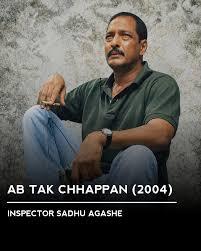
In the 2000s, he excelled as inspector Agashe, a stoic and ruthless encounter specialist in Ab Tak Chhapan (2004). He surprised with his role as a hilarious soft hearted underworld Don in Welcome (2007) who desperately wants to act with the heroine. But he will be remembered for his portrayal of the protagonist in Nata Samrat (2016), the Marathi masterpiece directed by Mahesh Manjrekar; considered as the finest performance of his career.
Portraying a theatre actor’s descent from a theatre king to a broken, vulnerable old mandealing with old age, family betrayal and descent in to poverty, Nana channelled a life time of dramatic excellence. His iconic throat ripping monologue when he says, “Will anyone give me a house?” He left theatre audience crying & giving standing ovation. Natsamrat is his most iconic film, a maudlin, must watch master class in Indian cinema.
The NAAM Foundation
In 2023, he acted as a tough no nonsense DG of ICMR in Vaccine War. He portrayed the role of an elderly man, grappling with early onset of dementia and memory loss in Van Vaas (2024). He also performed as Maat Saab in Sankalp, a serial this year, of a guru modelled on Chanakya who runs a mafia masquerading as Gurukul. He never needed to raise his voice to frighten, a rough and rasping voice that belonged to no one else in Hindi films.
A voice that went beyond cinema to care for distressed farmers, preventing suicide and building sustainable rural community through water conservation, education and disaster relief. The NAAM foundation he started in September 2015 will remain his greatest legacy as this organisation has revitalised rivers, desilted over 7 crore cubic meters of silt from rivers and built farm ponds to increase ground water and storage capability.
It provides financial aid, agricultural training, micro enterprise assistance, health charity cards to suicide affected and drought hit families. NAAM has delivered 705 sewing machines to women. One of the beneficiaries Sheela Suryavanshi from Latur district says: “NAAM helps me to live with dignity”.
The Multi-Faceted Nana
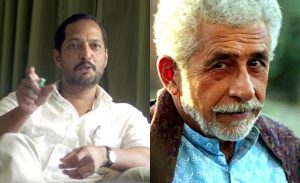 Nana & Nasir are considered unique pillars in popular and parallel cinema. Nana admired Nasir’s mastery over the craft of acting. Nasir was always keen to act with Nana; and the admiration was mutual. But as Muzzafar Ali rightly noticed, he carried the raw intensity of theatre & the instinctive immediacy of the street; and redefined arty acting in Hindi & Marathi cinema.
But Nana, the person, who drove in modest cars, lived in a one BHK flat in Mumbai and parted with most of his income for empowering widows, educating children and provides sustainable livelihood to vulnerable farmers makes him a hero in real life.
Randeep Hooda, the actor who dabbles in unusual roles says, “Nana is a real person who wears his heart on his sleeves”. Nana would cook meals on the sets and rapturously applaud Sneha Shankar for her lovely rendition of “Yeh Dil Tum Bin Kahi Lagta Nahin, Hum Kya Kare in Indian idol competition.
He had also his feet of clay when Tanushree accused him of sexual harassment during the Me Too movement. He could be mercurial and call a spade a spade. But he was a man of rare conviction and patriot of the highest order when he spent two weeks in LOC during the Kargil war, assisting soldiers & also spent time at a base hospital. He holds a mirror to our celluloid celebrities; how to bridge the reel and real life of a hero, and hold cinema as a mirror to humanity.



Leave a Reply
Be the First to Comment!