
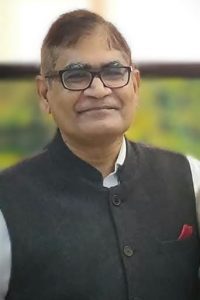
 By Satya Narayan Misra* in Bhubaneswar, July 27, 2026: On this date, 35 years back Dr Manmohan Singh as FM quoted Victor Hugo’s iconic lines: “No one can stop a moment whose time has come”, to unleash the process of economic liberalisation and sowed the seeds of privatisation and global integration.
The education sector witnessed mushrooming of private schools and Universities, which were unaffordable for the poor and lower middle class, while public schools and universities, barring a few elite ones languished in quality. The RTE Act 2009 made admission in to publicschools a fundamental right, while the quality remained sclerotic. The higher education system and the process of testing entry to the medical colleges and engineering degrees through the aegis of NTA smacked of paper leaks, opacity and lacked accountability.
This has triggered a massive student protest in Jantar Mantar, which was sought to be snuffed out by using brutish police force. Now that the Modi government has accepted all the demands and the student protest has been withdrawn, it can be legitimately construed as a Victor Hugo moment when education reform in the higher stream has taken the first baby step forward. It would be interesting to look back at the student movement which was steered earlier by JP in the 70s & the larger implication of this watershed moment.
The JP Movement
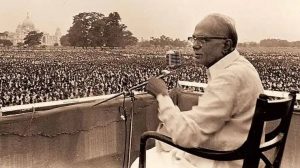 Jayaprakash Narayan Srivastava (popularly known as JP) – politician, theorist and independence activist spearheaded the massive student movement in the massive Gandhi Maidan, Patna in June 1974 where he gave a clarion call for total transformation of society, ridding it from the canker of corruption and ensure public accountability, which ultimately snowballed in to a national movement. In the Ram Lila Maiden, Delhi in June 1975 he quoted Ramdhari Dinkar: “Simhasan Khaali Karo Janata aatihai” (Vacate the throne, the public is arriving), imploring imperious Indira to resign.
Similar sentiment seems to have been echoed in Jantar Mantar early this month, when the students urged resignation of the union education minister, Dharmendra Pradhan. The Jantar Mantar protest also carries echoes of massive student protest in Paris in May 1968 to reform the outdated and medieval structure of the universities leading to temporary abdication of Presidential Chair by De Gulle. It was Herbert Marcuse, the father of the New Left and student protest movement who wrote in his seminal book “One Dimensional Man” (1964) how modern capitalism has pacified the working class through consumerism and how revolutionary changes would be driven by radical intellectuals, marginalised groups and rebellious students.
The Blighted Political Priority
Rabindranath Tagore, the Nobel laureate travelled across the world for nearly two decades. Everywhere he went; he interviewed educators, visited schools, and studied textbook and educational materials. Towards the end of these travels, he wrote a letter from Moscow in September 1930 in which he expressed the conviction that “education is the ideal path for solving all our problems”.
 Sadly, Nehru’s fascination with temples of modern India kept him away from the long haul effort of creating a world class education system in India as he spent less than 2% of Gross Domestic Product (GDP) on education as against as against 4-5% of GDP recommended by experts through their investigation of school systems elsewhere in the world.
His successor Indira constituted the Kothari Commission (1966) which strongly recommended earmarking 6% of GDP to education. But since then, the allocation has barely crossed 3% of GDP. Under her son Rajiv the National Policy of Education was promulgated in1986, with its thrust on universalisation, computer education. But the allocation has hardly moved up. But the biggest irony is that after School Education in Public Education became a fundamental right for all children in the age group of 6-14 in 2002 and launch of SSA (Sarva Sikshya Abhiyan), the share of education in GDP has barely increased to 3.5%, with school education accounting for 2.5% only.
What Really Ails India’s Education System
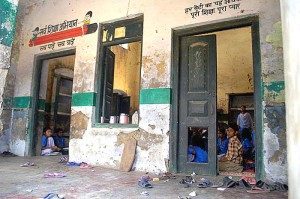 To be fair to the SSA and Right to Education (RTE) Act 2009, India has achieved remarkable success in terms of universal access and gender equity. In the tripod of Access, Equity & Quality, it is the Quality dimension which has been the biggest casualty. Successive reports of Annual Status of Education Report (ASER) bring out how 48% of standard V students can read text of Class 2, 24% can a read a sentence in English and only 25.6% can do a simple arithmetic division.
One of the thrust areas pointed out by the New Education Policy (NEP), 2020 is how to ensure foundational literacy and numeracy for all children by the age of 8 by 2025. This remains the most elusive goal as we talk about achieving Vikasit Bharat. Private schooling account for 35% and coaching centres proliferate.
This has created a serious hiatus between people of modest means who are in the majority and relatively affluent middle and rich class. The issue of malpractices in National Eligibility cum Entrance Test (NEET) and lack of accountability of NTA camouflages the larger challenge of our scandalously poor quality of education that our public schools dish out, where most of the parents send their children& its consequential impact when students study in colleges.
The Way Forward
The Constitution enjoins upon the states to ‘eliminate inequality of facilities and opportunity amongst not only individuals but amongst groups of people residing in different areas’. It is this lack of equal access to quality and affordable education in government schools and colleges which is the bane of education system in India. In his magnificent book Elites &Society, TB Bottomore had brought out how ‘organised elite rules the unorganised majority, when tiny groups control top decision’.
 India after a long time witnessed a serious protest against a very serious problem afflicting our education system, of which school education is the foundation and higher education a continuum for achieving good employability.
Our public education system needs a thorough over haul, with quality education as the pivot. Joseph Story, the noted jurist had observed that: ‘It depends on the present age whether the national Constitution will descend on its children in its masculine majesty, or shorn of its responsibility, it will become an idle mockery.
The Gen Z in their irreverent yet peaceful protest has shown that they can both be responsible and show fidelity to the constitution. It is just a spark at the end of the dark tunnel. The torch has to be carried further to purge education of its structural & fundamental fault lines.
*Prof Misra is an Emeritus Professor



Leave a Reply
Be the First to Comment!