
 By Satya Narayan Misra in Bhubaneswar, July 3, 2026: Ebrahim Alkazi, Habib Tanvir & Badal Sirkar are considered founders of modern Indian Theatre who freed Indian theatre from the melodrama of Parsee theatre of the 60s. While Ebrahim Alkazi revolutionised stage design and trained a generation of India’s finest actors, Habib Tanvir bridged the gap between classical urban drama and rural folk traditions, and Badal Da pioneered the ‘Third Theatre’, taking theatre out of stage in to open spaces.
Vijaya Mehta, a student of Ebrahim, became the queen of Marathi theatre, straddling the stage for nearly seven decades as actor and director, before passing away on June 30 at 92. Fondly called Vijaya –Bai, She was a theatre colossus, a cultural trailblazer who pushed the boundaries of both Marathi theatre & arthouse cinema as no one else. Though she worked extensively in Marathi theatre, she belonged to the world of theatre. Drama was part of her family DNA, as they loved old traditional plays and clever interweaving of laughter and tears. All that changed one day as she watched a play “Shantata Court Chalo Ahe”, a play written by Vijay Tendulkar which had none of the ingredients of traditional drama. Thus began a new journey of experimentation, a fresh approach, a fresh technology to drama by Vijaya Mehta.
The Distinct Foot Print of Rangayana
Despite her filmy connection, she chose theatre over mainstream cinema and co-founded Rangayana, along with Vijay Tendulkar, Arvind Deshpande and Sriram Lagoo in 1960, as an experimentation group to encourage bold story telling. Of the key plays staged by Rangayan were Mother (1961) and Ek Shoonya Baji Rao (1963), a landmark in contemporary Indian theatre. Anil Berne’s classic Hamidabai chi Kothi, where three visitors come to the house of Hamidabai, a famous tawaif, portrays ageing, female desire and social hypocrisy.
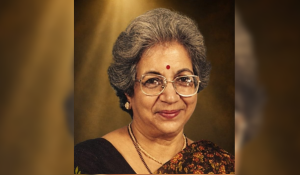 Vijaya stripped the play of any melodrama and let the silence speak of a culture that used her and then moved on. Vijaya as Hamida stripped the story of any maudlin melodrama. Hamida ran for decades in Rangayana. She brought Bertolt Brecht to the Marathi theatre, by staging his classic Caucusian Chalk Circle in Marathi folk style. She had an ally in Habib Hanvir who staged Brecht’s cult play ‘The Good Woman of Sezuan’ in Hindi. She used the same style in Girish Karnad’s famous plays Hayavadana in 1981 and Nagamandala in 1991. She collaborated with Fritz Bennewitz, staging plays in Berlin. Rangayan was for her ‘a laboratory for theatre.’
Lasting Impact on Parallel Cinema
While theatre remained her first love, she also made a lasting impact on India’s parallel cinema. Greatly impressed by Satyajt Ray’s unique oeuvre in Bengali cinema, that attracted global attention, and Shyam Benegal’s path breaking Hindi movie Ankur and Govind Nihalani’s superb movie Akrosh, she wielded the director’s baton in parallel Hindi cinema in the 80s, with Rao Saheb and Pestojee. She also acted in films like Kalyyug & Party.
Rao Saheb is a cult movie where in the 40s of Maharashtra, a young widow becomes the widow of a wealthy, ageing landlord Rao Saheb. It looks at power, desire, loneliness & how women navigate patriarchal society. She brought her theatre sensitivity in Rao Saheb, with long takes and simmering silence. Rao Saheb had the resonance of Hamida Bai, a confluence of patriarchy, social hypocrisy and decadence. In Pestonjee and Rao Shaeb she demonstrated the same precise and psychological depth that marked her excellence on the stage. RaoSaheb fetched her the National award for best supporting actress.
Her Lasting Legacy
She helped many actors –Nana Patekar, Ashok Saraf, Neena Kulkarni, Vikram Gokhale and Reema Lagoo, evolve in to the powerful performers they eventually became. She was like her mentor Alkazi in this aspect. Shabana who worked with her in Pestojee was anxious about portraying a Parsee. Shabana writes: “She wanted actors to collaborate with her, and not simply obey her. “Anupam Kher who played the lead in Rao Saheb observes “She never raised her voice. She raised your standards. Her discipline was wrapped in grace and her brilliance in simplicity.”
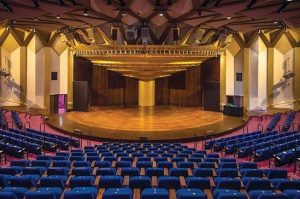 She was a great advocate of method acting and conducted sessions on Stanislavsky system of acting. As Chairperson of Mumbai based The National Centre for the Performing Arts (NCPA) during 1993-2010, she opened India to some of the world’s most influential practitioners Peter Brook, Barbara and Grotowski through production, workshops and exchange.
For nearly seven decades, she remained one of the rare directors, equally respected by actors, scholars & audience, lapped up by the cognoscenti and the hoi polloi. Whether directing or acting, working in theatre or appearing on the screen Vijya Mehta unobtrusively and emphatically made an abiding imprint. Indian theatre has lost one of its brightest luminaries. Amol Palekar writes in his autobiography” View Finder: “Theatre keeps an actor honest, no retakes, with no close ups to hide behind”. Vijaya was an amphibian who followed this precept as an actor and wielding the quiet baton of a director.
Satya Misra is a theatre buff



Leave a Reply
Be the First to Comment!