
 Professor Satya Narayan Misra* in Bhubaneswar, March 13, 2026: Euthanasia remains a deeply divisive issue, with the advocates arguing that the terminally ill patients should have the autonomy to choose a compassionate end to unbearable suffering while opponents stress about the sanctity of life. The Supreme Court in Gian Kaur Vs State of Punjab Case (1996) was of the view that right to live does not include right to die.
In a landmark case in 2011 involving Aruna Shanbaug, a nurse who was in a vegetative state for 38 years, the Supreme Court did not allow euthanasia, though it recognised passive anaesthesia. However, seven years later, in a petition filed by Common Cause, a NGO, the Supreme Court for the first time decreed that right to die with dignity is a Fundamental Right, legalized passive euthanasia,‘living will’ for a patient in a permanently vegetative state.
It also prescribed clear guidelines and advised the Parliament to bring in legislation in the field. This perplexing issue has come to roost with Justice Pardiwala and Justice Vishwanathan permitting the withdrawal of Clinically Assisted Nutrition and Hydration (CANH) for a 32-year-old engineering student Harish Rana who was in a vegetative state for over 13 years. This marks India’s first practical application of passive euthanasia.
Aruna Shanbaug Case (2011)
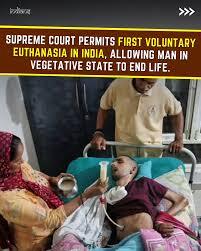 Aruna Shanbaug, a nurse at Mumbai’s KEM hospital was brutally assaulted by a janitor in 1973, while she was changing in the basement that left her in a vegetative state. Pinki Virani, a journalist & human rights activist, took up her case for euthanasia, citing her right to die with dignity. Justice Katju and Sudha Misra who heard the case rejected the mercy killing plea as she was still not brain dead.
The Court allowed passive euthanasia under strict guidelines. It invoked the doctrine of Parents Patriae, where the state acts as a guardian for individuals who cannot care for themselves, like minors or those incapacitated. The decision must be based on the principle of ‘best interests of the state.’ Aruna Shanbaug died in 2015 and did not benefit from withdrawal of life support.
Common Cause Case 2018
Prashant Bhusan who represented this case for passive euthanasia argued that the right to die sans pain and suffering is fundamental to one’s bodily autonomy. Chief Justice Dipak Mishra along with four other judges agreed with right of a dying man in a vegetative state to die with dignity. They differentiated between active euthanasia which involves intentionally causing a patient’s death through direct action, like administering a lethal dose, and passive euthanasia that involves withholding or withdrawing of treatment where there are no chances of survival.
Though sanctity of life has to be kept on the high pedestal, yet in cases of terminally ill patients, priority shall be given to the right of self-determination. The court allowed ‘living will’ for such patients where they can permit passive euthanasia. The Court provided guidelines for execution of these ‘living wills’ and where there are none, the court will exercise powers under Article 142.
The Harish Rana Case (2026)
Harish, an engineering student, sustained head injury when he fell from the fourth floor of the hostel where he was staying and was in a vegetative state for 13 years. Heeding to the plea of his parents for passive euthanasia after the medical boards had recommended as per SC guidelines of 2018, Justice Pardiwala and Justice Vishwanathan allowed withdrawal of life sustaining medical treatment including withholding of Clinically Assisted Nutrition & Hydration (CANH).
In a soul stirring judgement, Justice Pardiwala writes “The decision does not neatly fit within logic and reason alone. It sits in a space between love, loss, medicine and mercy.” Justice Vishwanathan observes: “Between the funeral pyre and mental worry, it is the mental worry which is more devastating. While funeral fire burns the dead body, it is the mental worry that that burns the living”. Justice Pardiwala wrote that right to die with dignity is inseparable from the right to receive quality palliative care and End of Life (EOL) care. Both the primary and secondary medical boards had concluded that there is no chance of recovery. For Harish’s parents, one is not sure if it’s an end to their mental worry.
Global Practice
Euthanasia continues to be a perplexing issue for all courts and countries ‘who often feel like a ship in an uncharted sea. ‘Those who argue against euthanasia believe that it is against the Hippocratic oath taken by doctors against intentional /voluntary killing. Progression of medical science & relieving pain will suffer a setback. One has also to take in to account the psychological pressure and trauma to medical officers to conduct euthanasia. David Benatar, a South African philosopher, who is known for his work on ‘antinatalism’ argues ‘that since individual does not have power to act at the time of their birth , no one should have authority over a person’s decision to continue living or to die.’ Some feel that discontinuation of artificial feeding is like severing air pipe of a deep sea diver.
Concluding Thoughts
Most countries seem to veer around legalising passive euthanasia. In UK, withdrawal decisions for incapacitated patient follow the ‘best interests’ doctrine. Australia allows discontinuation of artificial nutrition and hydration when treatment serves no purpose. USA recognises withdrawal of life supporting treatment based on patient’s autonomy and best interests. Uruguay in October 2025 has gone a step ahead by giving right to mentally sick adults in the terminal stage to request for active euthanasia.
In a famous case Lambert Vs France Case (2015), the European Court of Human Rights decreed that withdrawal of artificial nutrition or hydration did not violate Article 2, Right to Life, of European Convention of Human Rights. Hindus practice’ Prayopvesa’, where an elderly person or illperson chooses to fast to death, a dignified exit, to achieve moksha.
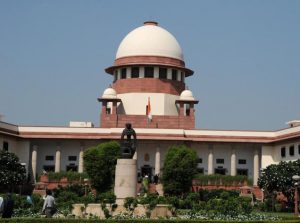 The Supreme Court has taken several landmark decision on increasing the contours of Right to Live,’ beyond just survival to live with dignity’ as in cases like Maneka Gandhi (1978), Olga Tellis (1985) and Vishaska (1997). However, right to die with dignity is a tricky terrain as both the Court and the State have to straddle between emotion and logic, love & loss, ethics and pragmatism. It remains to be seen if the State would come up with guidelines on this highly emotive issue.
*Professor Misra teaches Constitutional Law in reputed Law Schools



Leave a Reply
Be the First to Comment!