
Professor Satya Narayan Misra*, Dr.Manjusha Pandey** in Bhubaneswar, February 3, 2026: The Economic Survey as a precursor to the budget, while gloating over likely real GDP growth rate of 7.4% for 2025-26, had underlined four concernsviz; stagnant manufacturing, falling rupee, inadequate net inflow of FDI and absence of private CAPEX momentum. The FM has tried to assuage some of these concerns by underlining importance of ‘reforms over rhetoric’ through long term strategic and frontline manufacturing, and welcoming FDI through a slew of offers like tax holiday for cloud computing and reduction in custom duty. Besides, she has kept her feet on the pedal of public capex by increasing it by 11%, without eschewing the path of fiscal rectitude. While doing so, her neglect of adequate investment for quality education, skilling initiatives, R& D and measures how to arrest the down ward trend of TAX/GDP, continue to persist.
Budget at a Glance
|
Parameter |
2023-24 | 2024-25 | 2025-26 (RE) | 2026-27(BE) | |
| Revenue Receipts ( Lakh Cr) | 27.3 | 30.8 | 33.4 | 35.3 | |
| Capital Receipts | 17.3 | 16.2 | 16.2 | 18.2 | |
| Total Receipts | 44.6 | 47 | 49.6 | 53.5 | |
| Revenue Expenditure | 34.9 | 36.9 | 38.6 | 41.2 | |
| Capital Expenditure | 9.49 | 10.1 | 10.95 | 12.2 | |
| Fiscal Deficit /GDP % | 5.6 | 4.8 | 4.4 | 4.3 | |
| Tax/GDP % | 11.6 | 11.9 | 11.4 | 11.2 |
It would be seen from the above that public CAPEX will rise by 11%, but market borrowings will witness a spurt of 12%, while TAX/GDP shows a decelerating trend.
Standout Initiative
Of the 350 reforms referred to by Nirmala in her speech, four of them are transformationalviz; GST simplification, Bankruptcy Law, Formalisation/Digitisation, and the recent labour code reforms. The stand out feature of the budget is how to galvanise strategic & frontline manufacturing in areas like Semi-Conductors, Rare Earth Magnets, Chemical Parks, Electronic Components and Pharmaceutical.
Quite clearly, India is looking at the path trodden by China in increasing its share of manufacturing from 7.5% in 1997 to 30% by 2022, and having a global monopoly over manufacturing rare earth magnets. On the other hand, India’s share in global manufacturing has barely increased from2% to 2.5%.
 These initiatives will pave the way for self-reliance in critical areas of supply. It also is in line with National Manufacturing Mission (2025), as per which the share of manufacturing in GDP is proposed to be increased from around 13% now to around 25% by 2035. Manufacturing has enormous employment potential. Like the National Manufacturing Zone (NMZ) policy of 2011, whichhad set a target of creating employment opportunity of 10 million; the new manufacturing mission sets an ambitious target of creating 14 million jobs per year.
Other Initiatives
SMEs constitutes a major backbone of Indian economy contributing 31% of GDP, 45% of export, with 7.4 crore establishments of different sizes. The Economic Survey brings out how micro enterprises which constitutes 85% of MSMEs are hugely handicapped due to limited access to formal credit due to limited collateral. The Budget creates dedicated SME growth fund (10000 cr) , professional support and liquidity support through TReDS . Of the labour intensive sectors, the FM had paid special attention to the textiles sector which provides 45 million direct jobs. Their exports to USA has been seriously affected due to steep tariffs compared competitors like Bangladesh.The budget offers comprehensive package to rev up production of textiles and garments. The budget has increased allocation to Textile Ministry from Rs 3342 cr to Rs 5272cr next year, with allocation for PLI scheme increased from Rs 45 cr this year to 1168 cr.
To encourage inflow of FDI, the budget offers tax holiday for those willing to invest in cloud computing. It has alsogiven custom duty reduction in several areas for boosting export of marine, leather and textile products. It also plans to setup university townships and three 3 AIMS for Ayurveda. Besides accepting finance commission recommendation in terms of Article 281 to share 41% of taxable revenues with the states, it has allocated Rs 1..4 lakh crores as Grants-in aid in to the states terms of article 275 of the Constitution.
Major Concerns
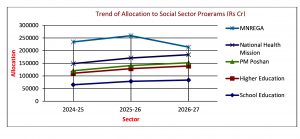
The budget disappoints in several areas, like allocation to school and higher education, Poshan, skilling & national health mission. This is despite the damning report of ASER regarding very low learning outcomes in government schools and NFHS V report which shows that nearly 33% of children suffer from malnutrition and more than 50% adolescent girls suffer from anaemia.
 The government also gives a fig leaf to World Hunger Index Report, where India ranks 102nd out of 123 countries, with a score of 25.8, indicating a ‘serious level of hunger’. It also pays scant attention to the India Employment Report (2024) released by Institute of Human Development & ILO which highlights a critical paradox of strong economic growth along side poor quality employment. It brings out how only 5% of the workers are skilled and casual workers and self employed workers is low as Rs 5000 and Rs 7000 per month respectively.
The last nail in the coffin is transformation of a right based employment programme for unskilled people of rural area to Centre mandated allocation, with states having to cough up 40% of the total cost as against 20% earlier. The allocation stands whittled down to Rs 30000 cr as against this year’s allocation of Rs 88000 cr. The following table will bring out these concerns.
Trend of Allocation to Social Sector Programs (Rs Cr)
 The Way Forward
Quite clearly,the recommendationof the NEP 2020 that the allocation be increased to 6% of GDP as against 3% for many years, and of National Health Policy which recommended health allocation to increase to 2.5% from the present level of 1.2% , is not happening , except for token incremental increase from year to year. The allocation to skilling is a measly Rs 6140 Cr. The allocation to R& D remains around .8% of GDP as compared to 2.43% by China which is trying to catch up with USA in the area of semi-conductors. A budget is a very powerful fiscal instrument for providing allocation priority towards social sector for capability development, promoting distributive justice, minimising unemployment and bolstering earning among bottom 50% of India. In her quest for reform over rhetoric, she seems to have turned a blind eye to the ‘pedagogy of the oppressed’.
*Professor Misra is a Professor Emeritus
** Dr Pandey is an Associate Professor & Data Scientist



Leave a Reply
Be the First to Comment!