
 By Professor Satya Narayan Misra in Bhubaneswar, January 23, 2026: Trump’s deposition of Nicolas Maduro’s aligns well with his National Security Strategy (2025), which thumbnails energy dominance as a core pillar of US power. Inventing drug trafficking to attack was a shenanigan to the larger design to gain complete control of oil deposits, limiting access for rivals like China and weakening OPEC’s influence over global pricing of crude oil.
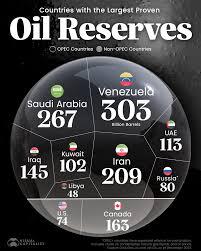
Maduro presided over a repressive kleptocracy which was held in place by arbitrary arrest, torture & extrajudicial killing since 2013. During this period (2013-2025) theGDP contracted by 70% to $82.77B, oil production plummeted from 2 million barrels per day to around 1 million barrels by 2025. As per the World Economic Outlook (October 2025) report, Venezuela sits on a debt / GDP of 180%. For a country which has the biggest reserves of oil globally, 303 billion barrels (20%), ahead of South Arabia (267 B), Canada (159B), Russia & USA at 80 B each, Trump’s marshalling of 17 oil executives to revitalise Venezuela’s oil industry is understandable, as they were the dominant players before 1945 and left Venezuela because of a spate of nationalisations, kick started by Perez in 1976 and accelerated under Chavez in 1998.
The Story of Oil in Venezuela
Until 1945, profits from oil went to American & British oil companies who ran the county via military dictatorship. In 1945, Betancart’s progressive left party was placed in power, allowed full civil liberties and imposed heavy taxes on foreign oil companies. In 1976 Perez nationalised part of oil industry and created the public sector company PDVSA. The second wave of nationalisation came in 1998 when Chavez came to power with an avowed objective of social welfare and anti-imperialism. He considered US involvement in oil companies as the’ greatest theft in the history of USA’.
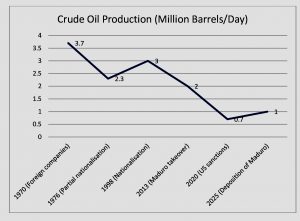
Awave of socialism swept through many Latin American countries like Brazil under Lula in 2002, Argentina under Kirschner, Chile under Bachelet in 2005. The only outlier was Mexico. This was the time when major companies like Exxcon left Venezuela. To fair to Chavez, % of people below poverty line went down from 54% in 1998 to 28% in 2008 because of social sector spending. However, Oil production dropped to 2 million barrels a day by 2013, the year when Chavez died. USA imposed sanctions in 2020 and by 2025 when Madurao was in saddle, the production per day has come down to 1 million barrel only.
The following table would bring out the trends..
Trump’s Crude Vision
During his meeting with 17 oil executives Trump asked them to improve the rickety infrastructure by bringing in technology and equipment, investing $10 b year which will ramp up production to around 3 million barrels a day in a decades’ time. Such optimism was not shared by the oil barons as they believe that the new projects will not be viable because of lack of labour, saturated market and political uncertainty that shrouds Venezuala. They also seem to believe that with further glut in production, the price per barrel will drop to $50 per barrel, which would not be cost effective.Though Trump remarked that ‘They are playing cute’, he would know as ashrewd business man that the corporates do not kowtow the government unless they sniff profit and are sure of the likely liability.It may be recalled how the US firms backed out of the Liability Law for nuclear damage 2010 , when the US India Civil nuclear deal was signed in 2008.
Opportunity & Challenges for India
 India was a major processor of heavy crude from Venezuela, importing around 4 lakh barrels a day till US sanction ticked in. OVL operated oil field in Eastern Venezuela. Venezuela has failed to pay $1 B to OVL for its stake in the field ÷nds. Once the sanctions are removed, OVL would move rigs and equipment provided Trumpapproves. Given his mercurial response towards India, it would be premature to rejoice in resumption of OVL exploration in Venezuela’s oilfields.
India’s foundational strategy of multi alignment is being severely tested by the return of ‘raw power politics.’ The strike forces a difficult question: Can diplomatic negotiation and institutional for a protect Indi’sinterest when faced with unilateral force of USA? The answer is unlikely as US is shifting away from cooperative global governance by withdrawing from 66 global institutions. Of particular concern is its withdrawal from UNFCC signalling that climate is no longer a core part of the US strategic calculus. The new forces are based on power and not principles, based on equity, respect for sovereignty, international law and multilateralism.
Twilight of the Global Order
BRICS, of which India is a member, is at the crossroads, as there are no security commitments between the members and theyhave limited capacity to respond to strategic shocks. India’s prevarication to take on the USA is in striking contrast to Brazil and China.Brazil’s President Lula described the attack as ’flagrant violation of international law’, China has denounced the operation as ’unilateral , illegal and bullying acts’. China which has financed nearly $60 B in Venezuela since 2005 will take stock of its limitation in this region. Russia has expressed solidarity with Venezuelaand urged restraint to avoid escalation. The European reaction is muffled by their limited defence capacity and lack of appetite for confrontation. This was clearly in evidence when the EU Chief Ursula sidled up to Trump to reduce tariffs.
India’s Options
Trump, while eyeing for oil fields in Venezuela also is trying to break the nexus between Cuba & Venezuela in matter of exchange of health officials from Cuba for Venezuela oil. Cuba being the greatest betenoire of USA since Castro days , Trump will like to strangle through economic blockade. In this kind of looming uncertainty of power play of Trump, there is a need for reinforcing energy resilience by diversifying suppliers, strengthening our strategic reserves and plug loopholes in supply chain vulnerabilities. It also provides an opportunity to deepen strategic partnerships with EU and expedite FTA with them. We need to keepingour doors open for Indo USA dialogue for clinching a favourable FTA. India’s policy of multi alignment is under severe stress.



Leave a Reply
Be the First to Comment!