
 By Nageshwar Patnaik in Bhubaneswar, December 10, 2025: The Kewda industry in Ganjam district is facing uncertainity due to lack of organized local marketing infrastructure, high GST rate of 18% on natural essential oils, proliferation of synthetic substitutes affecting the demand for natural Kewda oil, limited export linkages despite the GI tag and limited institutional support for research, branding, product diversification, and export facilitation. The crisis threatens the livelihood of more than 4,00,000 people, who depend directly or indirectly on the Rs 400 crore worth industry.
Government officials, industry stakeholders, farmers and experts deliberated on the impending crisis at a meeting last week under the chairmanship of general manager of Ganjam District Industries Centre last week following the grievance petition filed by Ganjam Kewda Development Trust (GKDT) regarding issues affecting the Kewda industry of Ganjam to the district collector. The Trust advisor, Dr. Purusottam Sahu submitted a litany of grievances of the once booming industry and suggested for Reduction of GST on natural essential oils from 18% to 5%, establishment of a Kewda Development Board under the State Government, Inclusion of Kewda cultivation under agricultural/horticultural support schemes. Strengthening and upgrading the FFDC Extension Unit, Berhampur into a national-level institute for aromatic crops.
Uncertain weather eventualities, particularly cyclones, have repeatedly damaged Kewda plantations over the past decade. Official data from the horticulture department shows that nearly 35% of traditional groves were badly hit during Cyclone Fani and subsequent storms, forcing many families to replant. Rising soil salinity is also a growing threat. Kewda plat thrives on brackish water, but too much salinity kills the roots. The industry now faces unprecedented climate stress that has survived purely because of inherited knowledge.
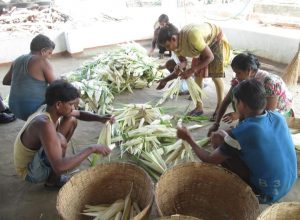 Across villages like in the blocks of Ganjam, Chhatrapur, Rangeilunda, and Chikiti, Kewda is not just another crop but a generational occupation. It binds families to the land and spreads fragrance across geographies. Odisha contributes over 80% of India’s Kewda flower production, according to the Odisha Kewda Development Corporation (OKDC), and Ganjam accounts for the largest share. Around 185 distillation units operate in the district, processing approximately 8.5 crore flowers annually, generating an estimated turnover of Rs. 400 crores. Kewda cultivation spans nearly 10,000 hectares, sustaining rural livelihoods, cultural heritage, and traditional skill systems.
For ages, human beings were enamoured by the sheer visual beauty of a flower, but it is a flower’s unique and charming smell that truly seduces us, and for good reason. Of the five senses, smell has been scientifically proven to be the most powerful, and the one most directly connected to our memoris: Familiar scents can instantly conjure remembrances, along with the exact emotions attached to them. Even scents that we’ve never encountered can quickly and silently affect our feelings, due to natural chemical reactions within the human body that don’t occur when our other senses are engaged. Ultimately, this phenomenon is what drives the perfume industry — especially the all-natural fragrance movement.
Of all the perfumes, Kewda fragrance is like a symphony of sweet and floral scents, with notes of rose, jasmine, and sandalwood blending together in perfect harmony. It’s a delicate and elegant aroma, with just enough sweetness to evoke feelings of happiness and joy. Kewra is used to flavor foods and for Ayurveda healing. The Kewda plant grows wild along the east coast of India. The plants that create the best floral bouquet are grown in Ganjam district in south Odisha.
Ganjam is renowned worldwide for Kewda Absolute Oil (Rooh), Kewda Attar, and Kewda Water. The industry has been thriving for over eight decades and is deeply interlinked with the socio-economic fabric of coastal Odisha. The district has a unique mix of marshlands and saline moisture that make kewda, known as Pandanus fascicularis, one of the most aromatic varieties in the world. The products have GI Tag No. 228 (Ganjam Kewda Rooh) and GI Tag No. 229 (Ganjam Kewda Flower), issued in 2012.
Despite local production, marketing and branding are dominated by agencies in Kannauj, Kanpur, Delhi, and other states, reducing value addition for local producers. Dharma Reddy, a Kewda plant farmer himself and a lawyer blames these agencies for the present crisis in the Industry. “The local economy has also suffered due to middlemen who controlled supply chains since long. Distillers had no bargaining power and were forced to accept whatever price was offered. They take the oil to Uttar Pradesh where they add value and make huge profit. We work day and night, but the profit went to others. Our children saw this and wanted to leave the profession,” Reddy said.
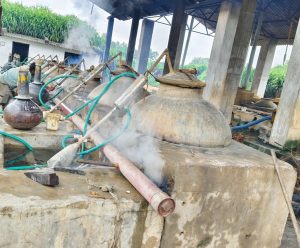 Kewda cultivation spans nearly 10,000 hectares, sustaining rural livelihoods, cultural heritage, and traditional skill systems. Around 185 distillation units operate in the district, processing approximately 8.5 crore flowers annually. Once collected, the farmers rush Kewda flowers to the traditional distillation units known locally as bhattis. Inside a bhatti, the flowers simmer slowly for hours until the vapour condenses into a pale, highly aromatic liquid. For every thousand flowers, barely 500-600 ml of extract is obtained, according to members of the distillers’ associations. The precious attar travels across India, to sweet shops, temples, paan sellers, and even to perfumeries in the Gulf. The best-quality attar from Ganjam can fetch up to Rs 18,000–25,000 per litre, depending on the season and market demand.
Despite technological innovations the distillers still use age-old techniques like copper degs, bamboo pipes, wood-fired furnaces and riverbank clay to seal the vessels. The process has barely changed in a century.
Favourable climatic conditions over the last 2–3 years led to increased flower production. However, in 2024–2025, Kewda oil prices declined sharply, making production costs higher than procurement prices, causing financial distress to local distillers, says V. V. Rama Rao, Deputy Director, FFDC Extension Centre, Ganjam. Besides, intermediaries from Kannauj and North India are receiving fewer orders from the tobacco sector due to the introduction of synthetic substitutes, resulting in reduced procurement of natural Kewda oil, he adds.
Incidentally, a major share of Kewda Rooh (absolute oil) is consumed by the tobacco industry for flavour and aroma enhancement. The usage ranges between 1% and 4%. However, while in April this year, the Rooh oil was around Rs 15 lakh per liter, it has come down to around Rs 8 lakh per liter. Then cost of production is about |Rs 10 to 11 lakh per liter leading to closure of almost 90 per cent bhattis, says P. Raju Reddy, President, Kewda Distillers Association, Ganjam. At present only about 10 bhattis are running at present, mostly by outsiders. He has urged the state government to immediate survey of all Kewda distillation units, including verification of Udyam registration and production capacity, is required, launch awareness initiatives should be undertaken to protect and promote the ethnic and cultural heritage of Ganjam Kewda.
 “Kewda Oil should be branded as an origin-based product of Ganjam and included under the ODOP initiative. GKDT should be supported to participate in national and international trade fairs to showcase Ganjam Kewda. A fresh proposal should be submitted to the Government for reduction of GST on Kewda Essential Oil from 18% to 5%”, he remarked.
Senior BJP leader and former deputy speaker, Odisha Assembly, who hails from |Ganjam district, sought the government intervention to save the Kewda Industries. “It is very unfortunate that once flourishing Kewada industry in my region is virtually in total shambles. Most importantly, lakhs of women depend on their livelihood on this industry in the area. I hope, the industry savvy state government will intervene and come out with a package to save the industry.



Leave a Reply
Be the First to Comment!