
 By Professor Satya Narayan Misra in Bhubaneswar, January 29, 2026: There is a general déjà vu that since the Indian economy has reached a sweet spot, with high growth (6.5%) and low inflation (2%), the upcoming budget need not change its trajectory. Prof Gita Gopinath, Deputy MD of IMF, has put a cat among cheerleading pigeons in World Economic Forum, Davos by observing how 18% of death in India is related pollution that needs urgent fixing. She apprehends that it can become a serious deterrent to foreign investment.
This is manifest as in 2025 FPI investors withdrew about $19 billion on a net basis from Indian equities.Besides, the net inflow of FDI during 2025-26 is barely $36 billion, which is negligible for a $ 4 Trillion economies. The gross inflow of FDI has been stuck around 1.7% of GDP, well below the 3% witnessed seen in the mid-2000s. The upcoming budget, would, therefore, need to shed its complacency and take measures to make India a preferred place for foreign investment. Besides it needs to break the prolonged plateau in private sector investment, generate greater employment opportunities and improve employability and income of a large number of workers caught in the low income trap.
Private Sector Investment
Capital expenditure as % total government expenditure went up from 12% (2012-2021) to around 16% from 2021-22 and during the last three budgets it has increased to around 22% of CGE. It has reflected in significant surge in investments in roads, national highways and railways. Even the most trenchant critics of Modi government are agreed that infrastructure investment and improvement has outshone the track record of Manmohan government . The Modi government has also been benign in the matter of corporate taxation. Despite all these initiatives, the private sector CAPEX is lagging behind the government sector as the following figure will show.
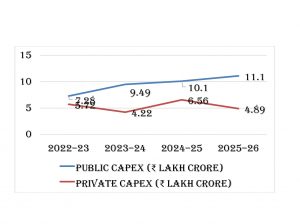
Besides, almost 80% private sector investment is being made by the cronies of the government, Adani, Ambani and Tatas, cornering infrastructure, energy and communication. The most proximate reason is that while public investment is autonomous, private investment is induced by consumer demand which has remained stagnant around 60%. Analysis of rural wages reveal how real wages have remained flat to negative for a long period of time. Besides high incidence of unemployment, low earnings dog the workers as revealed by the India Employment Report (2024). This has a consequential impact on stagnant demand and private sector investment over the years.
Employment, Earning & Employability
The India Employment Report (IER: 2024) brings out the asymmetry between Labour Force Participation Rate (LFPR)of Men and Women at 77.2% an 32.8% respectively, underemployment of 7.5% andlow monthly earnings of regular, casual and self-employed persons .
Monthly Earning Trends In Different Categories of Workers
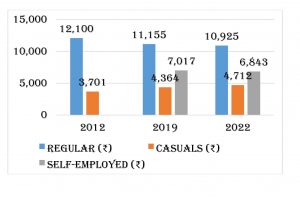
With close to 20% working as casuals, 58% self-employed and 22% in regular employment, the average monthly of roughly Rs 5000, 7000, 11000 in these three category captures the reality of low earnings in India and the dismal living standards of bulk of the Indians. This is largely due to poor education, low skill levels, poor vocational training.
Criticality of Manufacturing
It was Professor Nicholas Kaldor who had flagged the positive correlation between the growth of manufacturing output, GDP and productivity. Manufacturing has the best employment potential. Sadly, this sector’s contribution to the GDP has remained stagnant around 15-16% over the years. This is despite a roadmap of the NIMZ Policy (2011) to achieve 25% by 2022 and generating an annual employment of 10 million. This has happened in an asymmetrical manner, with states like Maharashtra, Gujarat, Tamil Nadu, Karnataka & AP doing reasonably well, while most other states languish in terms of manufacturing footprint . One of the key reasons for this is the endemic skill deficit that dogs India.
 Skill Deficit
The Niti Ayog in a perceptive Three Year Action Agenda (2017-2019) had brought out how only 5% of India’s workforce has undergone formal skill training compared to 68% in UK, 52% in USA, 96% in South Korea and 40% in China. Further, India’s skilling capacity at approximately 7 million annually is significantly lower than the workforce entering the market. Further, the quality of skills imparted in the existing facilities in India is a matter of concern. The Skill India Initiative was launched in 2015, with the aim of equipping 400 million people with employable skill by 2022. As against this target, only 16.4 million have been trained so far. Insufficient training facilities, qualified trainers, quality concerns have contributed to this huge shortfall.
Skill India program was allocated a measly sum of Rs 8800 crores for 2022-23 to 2025-26, focussing on industry aligned skills training and PMKVY 4.0 allocated Rs 6000 cr , targeting skilled youth in new age courses like AI and coding . as against1158 vocational schools in India, China has 11000 vocational schools, producing around 10 million skilled graduates annually. Since 2021, over 92 million workers have received financial support for skill training. No wonder, China dominates global manufacturing, accounting for 30% of global output, while India contributes approximately 1.8%.
The Way Forward
The budget has three dimensions viz allocation priority, revenue mobilization and fiscal prudence. It was Rosenstein Rodan who had suggested that the underdeveloped economies need massive, coordinated, large scale investment across multiple sectors to achieve sustained growth. China followed this model and has been the most dominant economy in the world today. The FM needs to allocatemuch higher budget for quality education and skilling to break the vicious cycle of low employability and earning ability. Also the budget needs to increase its R & D spend from the present level of .8% of GDP to at least 2%, as factor productivity is driven by technological advancement. India today stands at 39 in terms critical technology like AI, Semiconductor, bio technology, space and quantum technology.
The tax/GDP of India has struck a plateau at 11-12% over the years, unlike most developing and developed economies where it hovers between 16%-25%. This is largely due to massive tax evasion both in the informal sector and by the Corporates in cahoots with the government. On fiscal prudence the FM needs to be complimented for sticking by the spirit of FRBM Act, by targeting 50% as Gross Debt/GDP by 2030, she must show the spunk for meeting budget deficit through better & higher tax collection rather than the soft approach of borrowing from the market.
Prof Misra teaches Macro Economics



Leave a Reply
Be the First to Comment!